

- Home
- Health & Safety
- Conflict Resolution: Strategies for Communicating Level 3 Course
Conflict Resolution: Strategies for Communicating Level 3 Course
£15 + VAT


Written By Allison
- CPD Accredited | Instant Certificate | Mobile Friendly | Bulk Discounts Available
Trusted by care providers, healthcare organisations, businesses and workplace teams
The Conflict Resolution: Strategies for Communicating Level 3 Course develops practical skills for managing difficult, challenging or potentially escalating situations. Learners explore communication strategies, word choice, empathy, body language, personal space, active listening, appropriate questioning, reasonable force, incident reporting and post-incident support. It is suitable for staff, supervisors and managers who need to respond to workplace conflict safely, professionally and consistently.
Conflict Resolution: Strategies for Communicating Level 3 Course Summary
Course Name: Conflict Resolution: Strategies for Communicating Level 3 Course
Duration: 1 Hour
Delivery: Online Training Course
Certificate Included: Instant Digital Certificate
Accreditation: CPD Accredited – 1 CPD Point
Suitable For: Healthcare and social care staff, managers, team leaders, HR professionals, customer-facing employees and anyone who may encounter workplace conflict
Assessment: Online Multiple Choice Test – 70% Pass Mark
Access: Instant Access – 12 Months
Duration
1 hour
CPD Points
1
Last Updated:
25 Jul 2026
What is Conflict Resolution: Strategies for Communicating Level 3 training?
Conflict Resolution: Strategies for Communicating Level 3 training is an online course focused on communication techniques that can help prevent disagreements, challenging behaviour and potentially aggressive situations from escalating.
Learners examine factors that can influence conflict and how their own words, tone, body language, listening skills, questions and use of personal space can affect an interaction. The course also addresses reasonable force, withholding treatment, reporting incidents, post-incident effects, available support and debriefing.
These skills are particularly valuable in healthcare and social care, where staff may communicate with people who are distressed, frightened, frustrated, confused or angry. They are also transferable to customer service, management and other public-facing roles.
The course supports safer working practices by helping learners recognise how communication can reduce conflict and how incidents should be managed afterwards.
CPD Accredited
User friendly interactive courses
Instant Access
Enrol Now – Start Instantly
Certify Instantly
Certificate Available Immediately
Learn on Any Device
Train on Phone, Tablet or Computer
Money Back Guarantee
14 Day Money Back Guaratnee
How Would You Like to Access This Course?
Flexible options for individuals, staff teams and organisations
1
Instant Online Purchase
From 1 to 100+ learners • Bulk discounts available • Instant online access and certificates included
- Instant Access - No Quote Required
- CPD Accredited Certificates Included
- 100% Online & Mobile Friendly
- Assign Courses to Staff, Friends or Family
- Track Progress and Completions Online
- 14 Day Money Back Guarantee
£15 + VAT
CPD • Certificate included • Start instantly
Quantity
Per Course Price
1+ Courses
£15 + Vat
5+ Courses
£9.40 + Vat
10+ Courses
£8.49 + Vat
30+ Courses
£7.99 + Vat
50+ Courses
£6.49 + Vat
100+ Courses
£4.99 + Vat
2
Need Ongoing Staff Training?
Best value for teams of 8+ learners who need regular mandatory, induction and refresher training.
- Save Money on Staff Training
- Access Our Full 200+ Course Library
- Instant certificates issued
- Track Compliance Across Your Team
- Free Learner Replacements
- Reporting & Certificate Management
- CQC inspection ready
- Lowest price guarantee
- Dedicated Support
Best Price Guarantee • CQC Inspection Ready
When should I choose Caredemy Teams?
Caredemy Teams is ideal for organisations with 8+ learners who need access to multiple courses for mandatory training, induction training, and annual refreshers. Benefit from our best-value pricing, free learner replacements, compliance reporting, and access to our full course library. If you only need a small number of CPD courses, you can buy online instantly.
Access friendly, dedicated expert support whenever you need it, with guidance available throughout your learning journey
All-access individual subscription
Get unlimited access to 200+ CPD-accredited courses. One low monthly price. Learn anytime.
Buy any 5 courses for £47
Mix and max any courses.
CPD accredited - Certificates included.
Who Is This Course For?
The Conflict Resolution: Strategies for Communicating Level 3 Course is suitable for employees, supervisors and managers who may need to prevent, manage or respond to conflict as part of their work.
This includes healthcare assistants, nurses, care workers, support workers, receptionists, administrative staff, GP practice staff, care home teams, domiciliary care workers, NHS and independent healthcare employees, customer service teams and other public-facing workers.
It is also relevant to team leaders, supervisors, managers, HR professionals, project managers, compliance staff and people responsible for handling workplace disagreements, complaints or challenging conversations.
The course can support induction, refresher training and continuing professional development where conflict resolution and effective communication are relevant to an employee’s responsibilities and workplace risk profile.
Key Benefits
✓ Apply practical communication strategies to help de-escalate conflict
✓ Use empathy and active listening during challenging conversations
✓ Recognise how words, body language and personal space can affect behaviour
✓ Respond more confidently to difficult or escalating workplace situations
✓ Follow appropriate incident reporting and post-incident procedures
✓ Recognise when colleagues may need debriefing or additional support
Course Modules
- Conflict Resolution: Strategies for Communicating Level 3 Course Introduction
- Impact Factors
- Strategies for Communicating
- The Way You Use Words
- Using Empathy
- Body Language
- Using Distance as a Strategy
- Active Listening
- Questions with Care
- Reasonable Force
- Withholding Treatment
- Reporting Incidents
- Post-Incident Effects
- Types of Support
- Know What Support is Available
- Debriefing Meetings
- Changes Made
Ready to start?
Learning Outcomes
| Learner Outcome | Covered |
|---|---|
| Identify common triggers and factors that can cause workplace conflict | ✓ |
| Recognise early warning signs that a situation may be escalating | ✓ |
| Apply practical communication techniques to help de-escalate conflict | ✓ |
| Use appropriate words, tone and language during challenging conversations | ✓ |
| Demonstrate empathy when responding to people who are distressed, frustrated or angry | ✓ |
| Recognise how body language can increase or reduce tension | ✓ |
| Use personal space and safe positioning appropriately during conflict | ✓ |
| Apply active listening techniques to understand concerns and reduce misunderstandings | ✓ |
| Ask appropriate questions without unnecessarily escalating a situation | ✓ |
| Explain when the use of reasonable force may need to be considered | ✓ |
| Recognise key considerations when treatment may need to be withheld | ✓ |
| Follow appropriate procedures for reporting conflict, aggression or violent incidents | ✓ |
| Recognise the potential impact of an incident on staff and others involved | ✓ |
| Identify appropriate sources of support following a workplace incident | ✓ |
| Explain how debriefing and incident reviews can improve future working practices | ✓ |
Training 8+ Staff Across Multiple Courses?
Purchasing multiple licences for this Fire Extinguisher Training course? Simply adjust the quantity and buy online today.
If you need ongoing training for 10+ employees across multiple subjects, our Team Training platform provides access to 200+ CPD accredited courses, compliance reporting, learner management and bulk enrolment tools.
- Access 200+ CPD Accredited Courses
- Manage All Learners In One Place
- Compliance & Audit Reporting
- Bulk Enrolment & Certificate Tracking
- Dedicated Account Support
Team Training Solutions
Ideal for care providers, healthcare organisations and workplace teams training multiple employees.
Why Choose Caredemy?
- Instant Certificate
- CPD-accredited courses
- Money Back Guarantee
- Expert-designed training
- 120,000 learners trained
- Flexible online learning
- Compliance-focused
- Dedicated support
What Our Learners Say?
“Really useful communication techniques that I can apply when conversations with service users become challenging.”
Sarah Mitchell
Senior Care Assistant
“Clear explanations of de-escalation, active listening and what to do after an incident.”
James Walker
Team Leader
“Practical course that helped me think more carefully about my words, tone and body language.”
Priya Shah
Healthcare Assistant
4.87/5 from 168+ learners
Why Is Conflict Resolution: Strategies for Communicating Level 3 training important?
Poorly managed conflict can escalate into verbal abuse, threats, aggression or physical incidents. Effective communication can help staff recognise warning signs, respond calmly and reduce the likelihood of situations escalating.
The Health and Safety Executive advises that training can help workers prevent and manage workplace violence and may include recognising warning signs, verbal and non-verbal communication and incident reporting.
For healthcare and social care workers, these skills can help protect staff while supporting respectful interactions with patients, service users, relatives and colleagues. Training also reinforces the importance of reporting incidents rather than accepting aggression as simply part of the job.
Effective post-incident reporting and support allow organisations to identify patterns, review control measures and learn from what happened. HSE guidance specifically recommends recording incidents, reviewing controls and providing appropriate support following work-related violence.
Instant Course Certificate
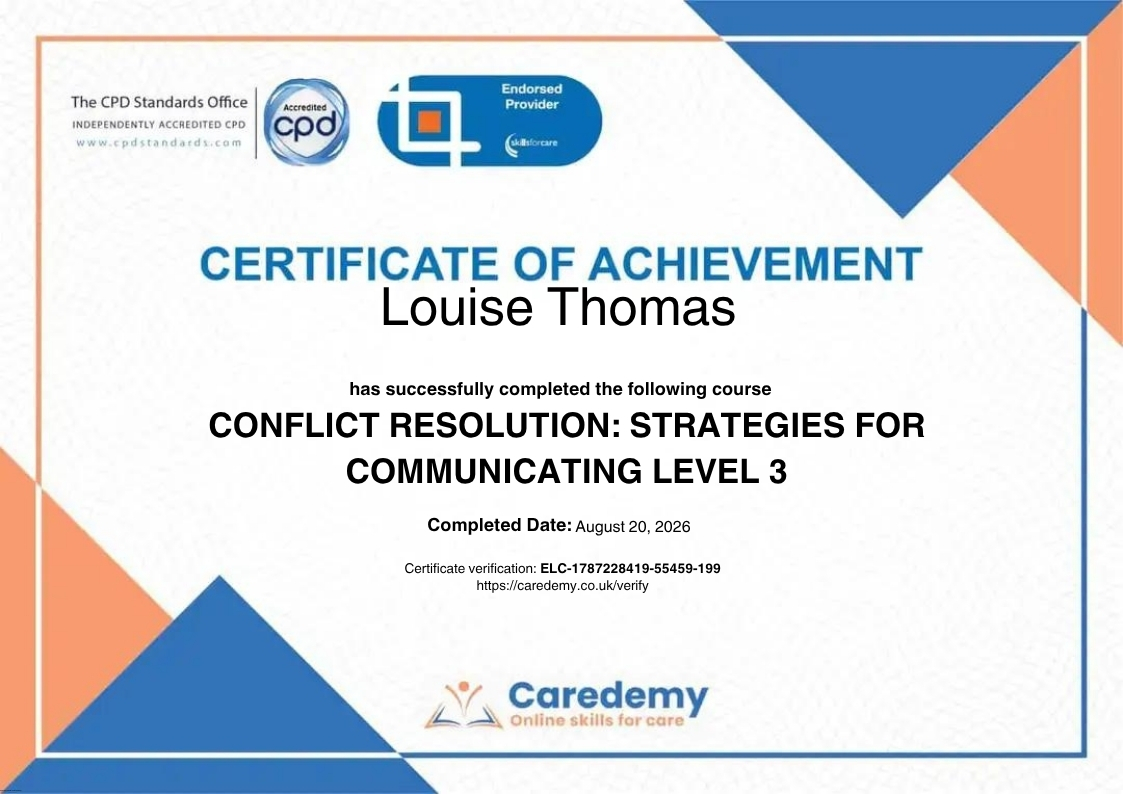
Is Conflict Resolution: Strategies for Communicating Level 3 training a legal requirement in the UK?
There is no general UK law stating that every employee must complete a course with this exact title or at Level 3.
However, employers have legal duties to protect employees from workplace health and safety risks, including work-related violence. The Health and Safety at Work etc. Act 1974 requires employers, so far as reasonably practicable, to protect workers’ health, safety and welfare. The Management of Health and Safety at Work Regulations 1999 require employers to assess workplace risks, including risks from violence and aggression.
Where a risk assessment identifies conflict, aggression or violence as a foreseeable risk, appropriate information, procedures and training may form part of the employer’s control measures. HSE states that training should reflect the specific risks identified in the workplace.
Healthcare organisations may also need to consider sector-specific requirements and guidance, including NHS violence prevention and reduction standards where applicable.
Trusted by 120,000+ learners
Trusted by care providers, healthcare organisations, businesses and workplace teams across the UK for high-quality online training
Office & Commercial
Health & Social Care
Industrial, Warehousing & Facilities
Hospitality, Retail & Public Services
Conflict Resolution: Strategies for Communicating Level 3 training FAQ?
What is Conflict Resolution: Strategies for Communicating Level 3 training?
Conflict Resolution: Strategies for Communicating Level 3 training teaches learners how communication can be used to manage challenging interactions and reduce escalation. It covers word choice, empathy, body language, personal distance, active listening, careful questioning, incident reporting and post-incident support, helping learners respond more safely and professionally when conflict occurs.
Who needs Conflict Resolution: Strategies for Communicating Level 3 training?
The course is suitable for anyone whose role involves challenging conversations or a foreseeable risk of workplace conflict. This can include healthcare assistants, nurses, care workers, support workers, receptionists, managers, customer service staff, HR professionals and other public-facing employees. Employers should determine training needs through workplace risk assessment and the responsibilities of each role.
Is conflict resolution training a legal requirement in the UK?
There is no universal legal requirement for every UK worker to complete a named conflict resolution course. However, employers have duties under health and safety legislation to assess and control foreseeable workplace risks, including violence and aggression. Where training is an appropriate control measure, employers should provide training suited to the risks employees may encounter.
How long does the Conflict Resolution: Strategies for Communicating Level 3 Course take?
The online Conflict Resolution: Strategies for Communicating Level 3 Course takes approximately one hour to complete and awards one CPD point. Learners receive instant access and can complete the training online using a compatible computer or mobile device, making it suitable for individual learning and workplace training programmes.
How often should conflict resolution training be refreshed?
There is no single refresher interval that applies to every UK workplace. Employers should review training according to their risk assessment, organisational policy, sector requirements, staff responsibilities and lessons learned from incidents. HSE recommends monitoring training needs and providing refresher training periodically so workers’ skills remain current.
What communication techniques can help de-escalate workplace conflict?
Useful approaches include speaking clearly and calmly, listening actively, showing empathy, avoiding argumentative language, maintaining appropriate personal space and considering your body language. HSE guidance also recommends acknowledging the person’s feelings and, where appropriate, offering alternative solutions. Staff should always follow their employer’s procedures and prioritise personal safety if de-escalation is unsuccessful.
What should happen after a workplace conflict or violent incident?
Employees should follow their organisation’s reporting procedures and seek appropriate support. Employers should record and review incidents to identify triggers, patterns and whether existing controls remain effective. Depending on the circumstances, post-incident support may include discussion with a manager, debriefing, changes to working arrangements or access to confidential support services.
Is this conflict resolution course suitable for healthcare and social care staff?
Yes. The course is particularly relevant to healthcare and social care environments where staff may encounter distressed, frustrated, frightened or challenging individuals. Communication, active listening, empathy, personal space, reporting and post-incident support are all relevant to reducing conflict-related risks. NHS England’s current Violence Prevention and Reduction Standard also emphasises prevention, reporting, staff support and appropriate training.
Need Training for Multiple Employees?
Train your entire workforce through Caredemy Teams with bulk enrolment, compliance reporting and access to 200+ CPD courses.
- CPD-accredited certificate
- Instant Certificate
- Learn of Any Device
- Money-back Guarantee
Related Courses You May Like


UK Regulations And Guidance

£15 + Vat
Conflict Resolution: Strategies for Communicating Level 3 Course
- CPD Accredited
- Instant Certificate
- Instant Access
- Bulk Discounts Available